

Who doesn’t love candles?
Sadly, using them frequently means being prepared to deal with candle wax accidents, especially when on your carpet. Forget about panicked scrubbing, though, if you don’t want to cause permanent damage to your precious floor coverings.
Here’s how to safely tackle candle wax so you can restore your carpet to its original condition.
Do Not Touch The Wax While It Is Hot
The most vital rule for protecting your carpet is to avoid using a cloth while the spill is still molten. That’s because most wax damage is caused by people trying to blot up the liquid immediately, before it has cooled or hardened.
Because wax is a lubricant when hot, any pressure applied simply pushes the oils deeper into the carpet pile and eventually into the backing. What you must do instead is to allow the wax to dry completely and harden.
If you need to speed up the process, place a handful of ice cubes in a plastic bag and rest it on the spill for about 10 minutes. This turns the wax from a sticky mess into a brittle solid that is far easier to handle.
Scrape Away The Hardened Surface
Once the wax is cold, its bond with the carpet changes. In recent years, many homeowners have rediscovered that mechanical removal is often more effective than chemical intervention.
In fact, did you know that up to 40% of a wax spill can be removed just by chipping it away before you even think about using an iron or a solvent?
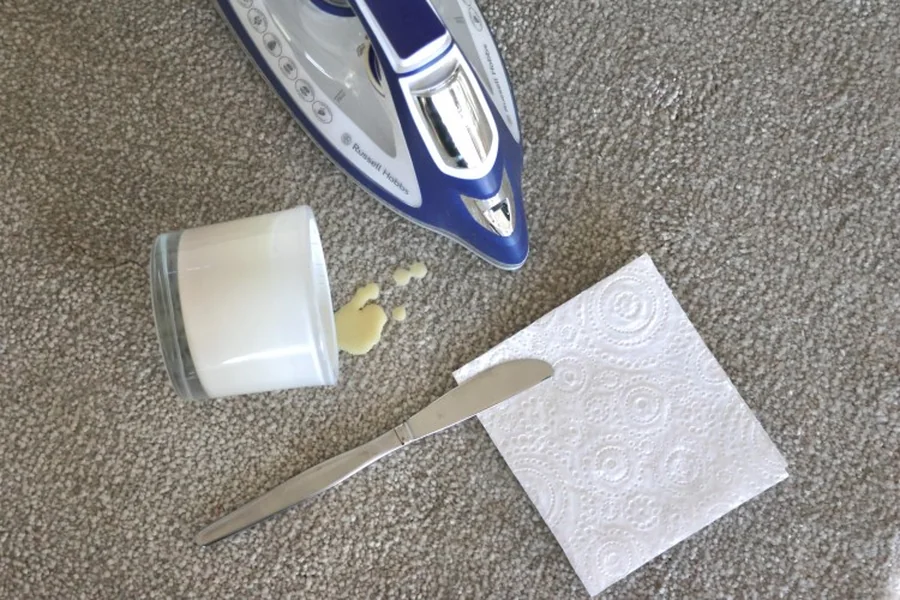
Simply use a dull tool, such as a butter knife or a plastic card, to gently flick the hardened wax off the grass. Then, vacuum up the dry flakes immediately so they aren’t trodden back into the carpet.
If you have a loop-pile carpet, be extra careful not to pull the threads, as this can cause a permanent run in the weave.
Tailor Your Approach To Your Carpet Type
Not all carpets react to heat and friction in the same way, so each kind requires a specific level of caution during wax removal.
The melting point of the wax is often lower than that of the carpet, but with synthetic fibres, that gap is dangerously narrow.
Here’s how to proceed, depending on your carpet type:
- Wool Blends: These are heat-resistant but highly absorbent. You can use the iron method safely, but ensure you don’t oversaturate the wool with solvents later, as this can weaken the yarn’s natural structure.
- Synthetic (Nylon or Polyester): These have a lower melting point than natural fibres. You must keep the iron on the lowest possible setting and keep it moving constantly. If the iron stays still for too long, you risk melting the carpet fibres themselves.
- Berber and Loop Pile: These are the most difficult to scrape. Because the fibres are looped, a blade can easily snag a thread and pull a long line out of your carpet. Use the iron method more heavily here to avoid having to scrape deep into the loops.
- Sisal and Seagrass: These natural plant fibres are very brittle. Avoid using too much water or liquid solvent, as these can cause uneven shrinkage or swelling, leaving a permanent “water mark” around the wax spill.
Lift The Residue With An Iron And Paper
Even after scraping, a thin film of wax will likely remain wrapped around the individual carpet fibres. This is where most people make the mistake of using boiling water or steam, both of which ruin the carpet’s texture.
Instead, the better, more professional choice is thermal extraction, which uses controlled heat to pull the wax upwards.
Wax has a specific melting point, so by re-liquefying it through an absorbent barrier, you can “wick” it out of the carpet and into the paper, leaving the fibres clean.
Place a brown paper bag or a thick white paper towel over the spot. Set your clothes iron to its lowest heat setting and make sure the steam setting is turned off.
Press the iron onto the paper for a few seconds. You will see the wax soak into the paper. Move to a clean section of the paper and repeat until no more wax appears.
Remove Any Remaining Colour From The Dye
If the candle was deep red or forest green, you might find the wax is gone, but a colourful “ghost” remains afterwards.
That’s because these dyes are often oil-based, meaning a standard carpet shampoo won’t do here. Nowadays, targeted spot cleaning has become the standard for maintaining the integrity of high-end wool blends.
Firstly, you have to realise that the pigment is a separate issue from the wax. What you need is a gentle solvent that dissolves the oils holding the colour without damaging the wool’s natural oils.
Proceed by applying a small amount of surgical spirit or white vinegar to a clean cloth. Blot the area gently, working from the outside in. The solvent will break down the dye, allowing it to transfer onto your cloth.
Be sure to always do a quick test on a hidden bit of carpet first to make sure your floor is colour-fast.
Neutralise The Scent And The Oil
Even if the carpet looks clean, scented candles leave behind fragrance oils that are naturally sticky. And, if left in the pile, these oils act like a magnet for dust and pet hair. This eventually leads to a dark patch forming over the next few months, often referred to as “resoiling.”
To prevent this, you have to sprinkle a layer of bicarbonate of soda over the area once it is dry. Leave it for at least two hours to soak up any lingering oils and odours, then vacuum it up thoroughly.
This final step ensures the area stays as clean as the rest of the room and prevents a “shadow” from forming.
When To Call Professional Carpet Cleaning Services
While the hacks above are highly effective for small spills, there are moments when the DIY approach reaches its limit.
Truth is, the cost of replacing high-end carpet far outweighs the price of a professional service call. Knowing when to put down the iron and pick up the phone can save your flooring from irreparable damage:
- Large Volume Spills. If a whole pillar candle has collapsed, the wax will have permeated the carpet pad. DIY methods only clean the surface fibres, leaving a solid “pancake” of wax underneath that will cause the carpet to feel hard and crunchy forever.
- Delicate Antique Rugs. For handmade Persian or oriental rugs, the heat from an iron can damage the natural dyes and silk threads. These require a “dry-cleaning” or immersion process that only specialists can provide.
- Persistent Staining. If you have removed the wax but a stubborn pigment shadow remains, further DIY blotting can lead to “over-wetting,” which causes browning or shrinkage. Professionals have the pH-balanced chemistry to neutralise dye without soaking the material.
- Multiple Old Spills. If you are moving into a new home or spring-cleaning an old room with multiple historic wax marks, a professional deep clean will reset the entire carpet’s texture and hygiene in just one visit.
Keep in mind that professional technicians use industrial-grade hot water extraction and specialised solvents that are safer and more powerful than domestic tools.
So, if you’re having trouble with wax spills, the best way to save your carpet is to simply call the pros and let them handle it.
Conclusion
Congratulations, now you know how to get wax out of a carpet safely, without ruining it in the process or resorting to expensive cleaners.
Try to keep in mind that lifting candle wax is a process that rewards patience over effort. So, take your time to freeze, scrape, and heat-wick a spill as that’s the only way to ensure a perfect result.
That way, you’ll enjoy candles and cosy evenings, while keeping the carpet looking great for years to come.
